Showing posts with label links. Show all posts
Showing posts with label links. Show all posts
Saturday, September 3, 2016
Animal Farm Audio Version
Some students are stronger auditory learners, and hearing the book is really helpful. I've included on the class blog a post a link to an audio version:

Friday, May 13, 2016
Writing 1 Class Notes -- Week 15 (May 12)
Greetings!
 And then it was time for our Poetry Jam. We finished Round One and proceeded to the Play-Offs. The Anti-Poetry League and the Pink Scriveners competed while the Team 'Murica served as our illustrious judges. They all did a marvelous job -- even those who really dislike poetry. In the end, the Pink Scriveners (Tadashi, Eden, Brady, and William) had a score of 7.811 that beat out the Anti-Poetry League (Brady, Samuel, Isabelle, and Jack) score of 7.458. Thank you Team 'Murica (Greta, Jeremiah, and Jonathan) for judging!
 Finally, we had our Final Exam for the class that looked a lot like a Jeopardy game. The class was divided into 3 teams and answered questions from the following categories: Grammar Terms, Writing Terms, Animal Farm, Jekyll Hyde, and Other Literature. (You can go here and see the game.) They did pretty well and had some fun in the process. Every year I hit up the huge Northfield Hospital Auxiliary Book Sale and pick up books to use as prizes, so it looks a little bit like Christmas on this last day of class.
 I'm pretty proud of these kids. They've written well, engaged well in class discussions, worked hard on homework, and been generally great all-around kids. We had a marvelous year reading and writing!
We've done it! We've reached the end of the CHAT school year successfully. I know that these great students learned a lot -- just compare their first essays with their final ones!
For the first time all year, we did not start the class with a Quick Write. Don't worry, we did pray, though. I was concerned that we might run out of time for our other activities. They've been such good sports all year long writing about whatever prompt that I give them. They have also bee great about sharing their thoughts with the rest of the class.
I handed back the last of the homework in my folder and collected the Final Writing Exam and the Reflection Papers. I appreciate the thoughts that they shared in their reflections about Writing 1. I've tucked away a few good ideas for next year. Unless I hear from a student, I will not send back these assignments.
 And then it was time for our Poetry Jam. We finished Round One and proceeded to the Play-Offs. The Anti-Poetry League and the Pink Scriveners competed while the Team 'Murica served as our illustrious judges. They all did a marvelous job -- even those who really dislike poetry. In the end, the Pink Scriveners (Tadashi, Eden, Brady, and William) had a score of 7.811 that beat out the Anti-Poetry League (Brady, Samuel, Isabelle, and Jack) score of 7.458. Thank you Team 'Murica (Greta, Jeremiah, and Jonathan) for judging!
 Finally, we had our Final Exam for the class that looked a lot like a Jeopardy game. The class was divided into 3 teams and answered questions from the following categories: Grammar Terms, Writing Terms, Animal Farm, Jekyll Hyde, and Other Literature. (You can go here and see the game.) They did pretty well and had some fun in the process. Every year I hit up the huge Northfield Hospital Auxiliary Book Sale and pick up books to use as prizes, so it looks a little bit like Christmas on this last day of class.
 I'm pretty proud of these kids. They've written well, engaged well in class discussions, worked hard on homework, and been generally great all-around kids. We had a marvelous year reading and writing!
I have a few late bits and pieces of homework that have come in from students. (If anyone has anything they haven't handed in, please get it in by next Thursday.) Once those have been graded and I have everything entered in Engrade, I will get the grades sent out. My goal is to have them done by next Thursday.
Assignments for Next Week:
-- ABSOLUTELY NOTHING!!
This week's links:
Class Notes
Have a great summer!
Mrs. Prichard
Sunday, March 20, 2016
Writing 1 Class Notes -- Week 8 (March 17)
Greetings!
This week in class we started with a Quick Write that asked about family heritage since it was St. Patrick's Day. While my kids are "mutts," a blend of 8 or 9 nationalities, we have incorporated some Scandinavian traditions into our family celebrations. As I write this, I'm thinking that it would be fun to incorporate some those British, German, and Scotch-Irish elements into our family, too.
The Words of the Day were short words or words for very small items:
aglet -- fr. OF aiguillette, a small needle -- the plastic or metal end of a shoelace
chad -- origin unknown -- a small round or square bit of paper formed when a hole is punched
grommet -- fr, OF gromette, curb of a bridle -- a metal or plastic ring encasing and reinforcing a hole
vim -- fr. an Americanism; fr. Latin vis, energy, force -- a lively and enthusiastic spirit
mauw -- fr. German, maul, muzzle -- the mouth, throat, or gullet of an animal
I handed back the Rough Drafts of the Themes/Character Essays. The class did a wonderful job with this assignment. When I hand back rough drafts, I like to use that as an opportunity to go over common errors. Students can learn points of grammar with worksheets, but it makes the most sense in the context of their own writing. I had the students come up and list on the board errors that were on their own essays, and then I added a few others. We also talked briefly about plagiarism, which is taking the data, information, or comments of another and writing them as if they are your own. It's good to add insights from others, but it's important to give credit where credit is due. (We will cover this more in Writing 2)
The class had read 2 O. Henry short stories for this week: "Makes the Whole World Kin" and "The Furnished Room." We read aloud portions of first one and discussed it.
For the past few weeks, during the Grammar portion of class we've been learning about various types of phrases. Now, we're moving on to types of sentences and elements in a a sentence.
Assignments for this Week:
Read "Retrieved Reformation" and "Pimienta Pancakes"
Fill out one Short Story worksheet for each story (both sides)
Final Drafts of Themes/Character Essays
Grammar Worksheets -- 9.2 and 9.3
Links for this Week:
Class Notes
Retrieved Reformation (audiobook)
Retrieved Reformation (Listen & Read)
Pimienta Pancakes (audiobook)
Have a beautiful week!
Mrs. Prichard
Saturday, February 6, 2016
The Strange Adventure of Dr. Jekyll and Mr. Hyde -- Audio versions
While our book for the Spring Semester is not very long or overly challenging, students who are strong auditory learners my benefit from an audio version of the story. If students choose to listen to these, I encourage them to read along with their hard copies of the book.
Below are some options:
Sarah Kay's "Hands"
Our Quick Write began with a discussion about figures of speech and cliches related to "hands." We compiled quite a list:
I gotta hand it to you; in the palm of my hand; being fingered for a crime; wrapped around my finger; 5-finger discount; back of my hand; a slap in the face; thumbs up/down; give me five; lend a hand; hand it over, etc.
After this little brainstorming, I asked the students to write something about hands. They could use some of our cliches or they could write about the use of their hands. When they were done, I had them watch a short video about hands by spoken word artist, Sarah Kay.
Saturday, October 10, 2015
Adjectives Videos
Below are the videos for the Adjectives Presentation.
This video was produced by the presenters for Writing 2.
Friday, September 4, 2015
Animal Farm Audio Versions
Some students are stronger auditory learners, and hearing the book is really helpful. I've included on the class blog a post a link to an audio version:
Animal Farm Intro Videos
George Orwell intentionally wrote this novel with Russia, Stalin, Trotsky, and socialism in mind. Below are some videos that will give some historical background to this insightful novel.
Sunday, April 13, 2014
Writing 1 Class Notes -- Week 12 (April 10)
Greetings!
Our Writing 1 Class went well this week, and I'm sure that most of the students are looking forward to having another break from CHAT classes for our Easter break. We'll resume classes again the week following Easter/Resurrection Sunday.
 Our Words of the Day were words that sound the same, spelled the same, but have different meanings:
The Quick Write for this week recognized Washington Irving, an early American writer whose birthday was this month. Though most of the students were unfamiliar with his writings, I'm sure parents are familiar with his two well-known stories, "Rip Van Winkle" and "The Legend of Sleepy Hollow." Since Rip Van Winkle was a lazy man whose plan to get out of work cost him 20 years of his life, I asked the students to think about and write about their favorite getting-out-of-work strategies. I heard some very interesting ideas from this creative group of students.
Our Words of the Day were words that sound the same, spelled the same, but have different meanings:
principle (a basic belief or primary idea) & principal (the leader of a school)
capitol (the building that houses a state's or nation's legislature) & capital (the primary seat of government)
council (an assembly of persons with a focus/goal) & counsel (wise advice)
Embedded in this discussion were some other terms related the relationships between certain types of words. Below are some helpful definitions:
homograph -- words with the same spelling, different sound, different meaning. E.g. The wind blows/ Wind the clock. Lead the people to safety./ Avoid using paint with lead in it. The desert has sand./ Don't desert your friends.
homonym -- words with the same sound, same/different spelling and different meaning. E.g. Spruce up the house./I have a spruce tree. I will pay a fair price./ Will you go to the fair?
homophone -- words with the same sound, different spelling,and different meanings, E.g. to/two/too. their/they're/there
synonym -- words that mean the same. E.g. big/large/huge/immense/colossal/sizable/massive
antonym -- words that are opposites. E.g. hot/cold; huge/tiny; wealthy/poor
I handed back to them the Rough Drafts of the most recent essay, a News Story. In class we discussed some of the common errors and mistakes that I found as I read them. In addition to revising and editing their rough drafts, I also want them to fill out a self-evaluation for their essay. These self-evaluations give them time to reflect on their own writing. I've handed out the rubric that I use when grading the essays. On the back side of the self-evaluation sheet, I would like them to list 5 corrections they made on their essays and explain their reason for the correction.
We're continuing to read from our Poetry book. I divided the class into 4 groups and assigned a poet to each group. They were to select one of their poets poems to discuss and then to prepare a discussion question to share with the class. All of our selections this week were from either the Romantic or Victorian period of British literature. I loved hearing them mull over the ideas, style, and meanings found in their poems.
About the Poetry Presentations: I have scheduled Presentations for the last 2 classes of the semester. (James is going to help me put this together.) At the other school where I teach, they hold annual Poetry Out Loud competitions and have hosted a Poetry Slam. In a Poetry Out Loud competition, students recite poetry from a pre-selected list. Poetry Slams, on the other hand, feature original poetry. In past years, we've done at the end of the school year what I have called a "Poetry Slam Out Loud." Students can choose to either recited poetry from our book or recited something they have written.
Assignments for April 24:
-- Read poems by the following poets:
Shakespeare: Shall I Compare Thee to a Summer's Day? When, in Disgrace with Fortune and Men's Eyes, Let me not to the Marriage of True Minds
Donne: Death, Be Not Proud
Jonson: Drink to Me Only with Thine Eyes
Quarles: On the World
Carew: The Unfading Beauty
Milton: On His Blindness
-- Finish Final Draft of News Story
-- Complete Self-Evaluation and 5 Corrections
-- Be thinking about your poetry selection for our Poetry Presentations.
This week's links:
Class Notes
Have a great week and very blessed Easter!
Mrs. Prichard
Saturday, April 5, 2014
William Carlos Williams's Red Wheelbarrow
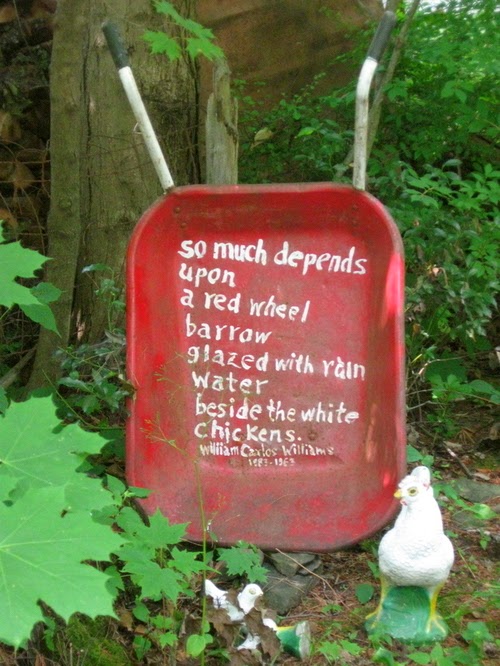
We took a good portion of our class time to discuss one of my favorite poems in class. Over the years, William Carlos Williams's poem, "A Red Wheelbarrow," has wiggled it's way into my head. Every year, I do my best to get my students to join me in appreciation of this short, 8-line poem.
If you would like to explore this poem further, check out the following links:
An analysis by Craig Morgan Teicher
The Modern American Poetry association offers a variety of viewpoints.
An essay on whether the poem is simple or complex.
A dissection of this minimal masterpiece
 You can even watch a video presentation that analyzes the poem.
Friday, March 14, 2014
"The Ransom of Red Chief"


Below are some links to some productions/presentations of this story:
A short video (about 1/2 hour long)
A longer full-length movie
A radio theater presentation

A high school play
A High school English project
A video clip from the Disney movie, No Deposit No Return, an adaptation of the story.

Friday, February 21, 2014
Links to Videos for Week 6

Greetings Class!
Below are some helpful links for our new book of short stories by O. Henry. The website with information is from Wikipedia. (Information about O. Henry)
After Twenty Years
Librivox Recording
Legos & the Story
Dramatization by High School Class
The Gift of the Magi
Librivox Recording
Video
Video with story text
Saturday, February 15, 2014
Week 5 Grammar Exercises

Class,
If you want some more practice with the pronouns "who" and "whom," here are some online games that might be helpful:
Word Choice — Exercise 6: Who and Whom
Word Choice — Exercise 7: Who and Whom
Word Choice — Exercise 8: Whoever and Whomever
Saturday, October 26, 2013
Helpful Links about Subordinating Conjunctions and Prepositions
Most of the students in class tracked with the discussion comparing prepositions and subordinating conjunctions. For those who would like to read more (or for parents who've forgotten their high school grammar) below are some links that also explain subordinating conjunctions:
Grammar Clubs page on Subordinating Conjunctions and Dependent Clauses
A Yahoo Answers page
The Tongue Untied page
Zane Education page
The ChompChomp site (which also has a lot of worksheets)
Thursday, March 7, 2013
Why Latin?
This semester I'm including Latin phrases into our beginning-of-class activities. My reasons for doing this are varied:
1. I love words, and Latin vocabulary expands our personal word banks, qualitatively and quantitatively.
2. Writing is the art of using words well. (see #1).
3. While some may complain that the Latin phrases used are archaic and therefore not useful, I disagree. Neither are they little bits that might help you in a trivia contest. Most of the phrases we discuss have connections to culture, history, the legal world, art, science, etc. While we don't go into any great depth with these topics, I hope I'm salting their curiosity.
4. Students are beginning to make connections with other topics they've studied and are communicating their knowledge with the rest of the class. For example, when we looked at the phrase ars moriendi (the art of dying), one student shared what he had learned about the Roman military culture.
5. Though I'm teaching writing, one of my primary goals is to encourage critical, creative, and analytical thinking. When students learn to think broadly and diversely, they also grow as writers. I feel that these Latin expressions help to generally expand their thinking skills.
Some interesting articles:
Teaching Latin in Primary schools in the UK
10 Reasons to NOT teach Latin (for those who don't like Latin)
Latin Makes a Comeback
Why Teach Latin
As with any of the content of my classes, feel free to contact me.
Thursday, January 24, 2013
Resources for The Strange Case of Dr. Jekyll and Mr. Hyde

As students are reading, the sites listed below might help them, especially when we write the Character or Theme Essays later in the semester.
LibriVox recording -- For strong auditory learners, hearing the book may help them comprehend more of it. This site has a free recording of the whole book.
University of Virginia's e-text version -- Should a student lose or be unable to find their copy of the book, this site gives the written version of the book in its entirety.
A study in dualism: The Strange Case of Dr. Jekyll and Mr. Hyde -- A literary analysis of this aspect of the book.
Dr. Jekyll and Mr. Hyde Notes and Analysis -- Like the SparkNotes site for this book, this site gives summaries and added insights, and should be read AFTER the student has read (or listened to) the text.
Thursday, October 11, 2012
Biography Essay Links
Below are some helpful links for the students and their biography essays.
Hope these help.
Subscribe to:
Posts (Atom)